
In this article
- A café break-in: why the stolen cash wasn’t the biggest risk
- CCTV, smart alerts and monitored alarms: what’s the difference?
- Someone is inside the shop now. Do you call 000?
- Would a barking dog deter a burglar better than a camera?
- Insurance after a break-in: what should cafés and property owners check?
- A practical seven-point security check for homes and small businesses
- Frequently asked questions
- Official sources and original community-library research
Can security cameras prevent a break-in, or do they simply capture evidence afterwards? A recent incident at a specialty coffee shop in Victoria illustrates the difference. The CCTV recorded a masked intruder, but the owner did not learn about the break-in until the following day.
Quick answer: CCTV footage can help police investigate. A system with properly configured motion alerts, intrusion sensors or professional monitoring may make it possible to detect suspicious activity earlier. But a phone notification is not an automatic police dispatch, and no system guarantees that an offender will be caught. Security is most useful when detection is linked to a safe response plan.
A café break-in: why the stolen cash wasn’t the biggest risk
On 18 November 2026, a café owner described discovering that the premises had been entered overnight. The owner also reported break-ins at other shops along the street. The café’s high-definition cameras showed a figure wearing black clothing and a face covering, with white sports shoes. Those details are observations; they do not establish the person’s identity or criminal history.
Just over $100 in cash was reportedly taken, with no obvious damage to the coffee machine or other valuable equipment. The owner was relieved that prized, award-winning coffee beans remained untouched. For a small business, however, the more expensive scenario might have been a damaged espresso machine, emergency repairs or days of lost trading.
This does not mean it is wise to leave cash for a thief or use weaker locks to avoid property damage. The outcome was fortunate, not a security strategy. Victoria Police advises businesses to manage and minimise cash risks.
CCTV, smart alerts and monitored alarms: what’s the difference?
| Security measure | What it can do | What it cannot promise |
|---|---|---|
| CCTV recording | Preserves footage and may deter a visible offender | Someone will notice the incident immediately |
| Camera with phone alerts | Sends motion/person notifications for remote review | Every alert is accurate, seen or acted on |
| Intrusion alarm | Detects configured door/window or indoor events; may sound a siren | Automatic attendance by Victoria Police |
| Professional monitoring | A service may check alarm signals and follow an agreed escalation process | A response time or outcome without verifying the contract |
Victoria Police advises owners installing CCTV to consider night-time image quality, camera placement, secure storage, and pairing cameras with sensor lights and alarms. It also suggests looking for systems that send alerts to a mobile phone. Avoid filming neighbours’ private areas, and secure your camera account and recordings.
Before buying a subscription or new device, ask: Does it detect people or simply any movement? Can more than one person receive alerts? What if the internet or power goes down? Is the phone set to silence notifications overnight? Who checks the alert if the owner is travelling?
Someone is inside the shop now. Do you call 000?
If you believe a break-in is happening, someone is in immediate danger or urgent police attendance is required, call Triple Zero (000). Give the location and what you can actually see. Do not drive to the property to confront an intruder or ask neighbours to enter an unsafe building.
If the break-in has already happened and there is no immediate danger, Victoria Police provides an online burglary reporting service and the Police Assistance Line on 131 444. Keep the incident reference number, original CCTV files, a list of missing items and photographs of damage. Police guidance also identifies additional circumstances in which 000 is appropriate, including forced or violent entry, weapons, or multiple offenders; follow the current official guidance.
What about alarms that notify the police? Victoria has an Alpha Code process for eligible, licensed and graded security monitoring companies that request assistance for defined Category A alarms. This is not something an ordinary internet-connected camera automatically provides. Check an alarm provider’s licence, monitoring terms, verification process and escalation arrangements before assuming police are notified.
Would a barking dog deter a burglar better than a camera?
Dogs are interesting because barking can attract attention before a homeowner checks a screen. In a 2014 Australian Institute of Criminology study involving detainees in Western Australia, 61.4% identified dogs as a possible deterrent, compared with 49.1% for working alarms and 22.8% for sensor lights.
These percentages are the responses of a particular study group—not burglary prevention success rates, and not proof that dogs outperform CCTV in modern Victoria. The same dog may bark at a delivery driver, miss an intruder or be unattended. RSPCA Australia’s 2026 policy opposes using dogs solely to guard premises because of welfare risks and alternatives such as cameras and alarms.
If your family already has a dog, its alertness may be a helpful extra layer. It should not be expected to confront offenders or be acquired solely as a security device.
Insurance after a break-in: what should cafés and property owners check?
A $100 cash loss can be small compared with replacement locks, broken doors, stolen stock, damage to a commercial coffee machine, and interruption to trading. Business.gov.au distinguishes building and contents insurance, burglary insurance and business interruption insurance. Coverage is subject to each policy’s insured events, limits, conditions and exclusions.
Some cash losses or equipment costs may require particular cover or sub-limits. The excess also matters: if your only covered loss is $150 and the applicable excess is $500, a payment will usually not result. When several kinds of damage occur together, ask the insurer how they are assessed rather than assuming the outcome.
For a leased shop, check the commercial lease before assuming the tenant or property owner must pay for the door. For a residential rental, the repair obligations and insurance position are different again. Contact the insurer promptly about evidence requirements and necessary emergency repairs, and keep photographs, quotes and receipts.
A practical seven-point security check for homes and small businesses
- Test what your existing cameras do: Can you review footage remotely? Are the images usable at night?
- Test alerts safely: Check phone delivery, sound settings and false alarms without triggering an unnecessary emergency response.
- Review doors and windows: Maintain suitable locks, visible entrances and sensor lighting without blocking emergency exits.
- Set a response plan: Identify who is contacted and when 000 or 131 444 is appropriate. Nobody should confront an intruder.
- Protect recordings: Restrict account access, use strong credentials and retain unedited footage when an incident occurs.
- Check property and business cover: Review theft, cash, equipment, interruption, exclusions and excess, not just the annual premium.
- Talk to neighbours or nearby traders: Share verified safety concerns without publishing private footage or accusing identifiable people.
Frequently asked questions
Can I call 000 after an alert on my phone?
Yes, when the circumstances indicate a crime in progress, immediate danger or a need for urgent police attendance. A movement notification alone is not confirmation of a crime; assess remotely if safe, and give police accurate information.
Do CCTV cameras automatically contact Victoria Police?
Usually not. Ordinary camera notifications go to users or an app. Particular professionally monitored alarms have separate procedures; confirm the precise service before purchasing.
Will commercial insurance pay for stolen cash or a broken coffee machine?
Only if those losses fall within the actual policy and conditions. Check money limits, theft and equipment cover, exclusions, excess and whether interruption of trade is covered.
Official sources and original community-library research
- Victoria Police — Report an incident or crime
- Victoria Police — Installing CCTV
- Victoria Police — Alpha Codes and alarm responses
- Victoria Police — Business premises security
- Australian Institute of Criminology — Burglary deterrents (2014)
- RSPCA Australia — Working animals policy C3 (2026)
- Australian Government — Types of business insurance
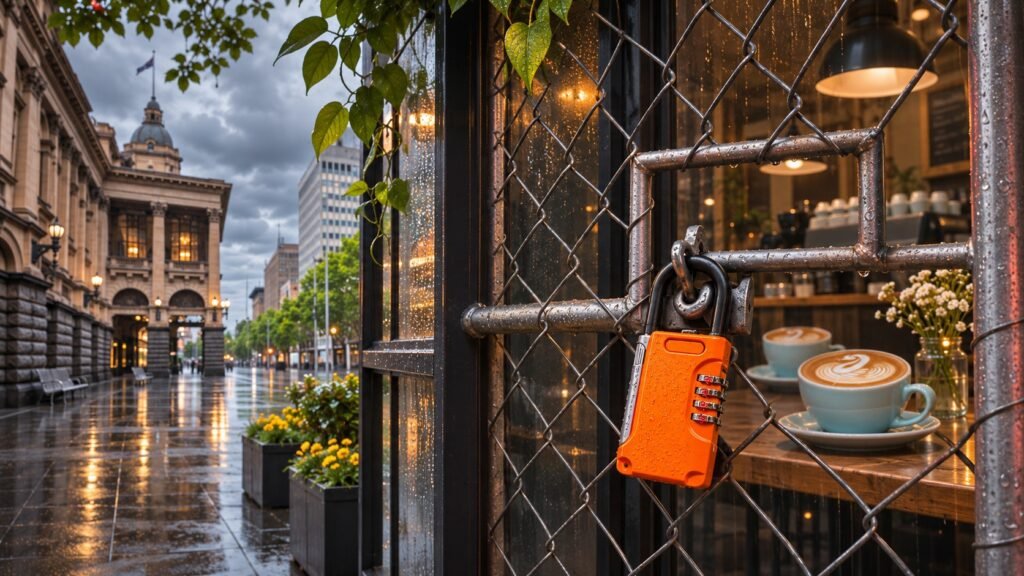
This article is adapted for APOA website readers from the APOA Community Library’s original Chinese research and case discussion. The reported café incident is anonymised and has not been independently verified. The featured image is an illustrative reconstruction, not a photograph of the incident.
General educational information for Victoria, Australia, checked 19 November 2026; not individual police, legal, security or insurance advice. Official guidance and policy wording take precedence.