
In this article
APOA media fact-check | 21 November 2026 | Source tracing and official rules
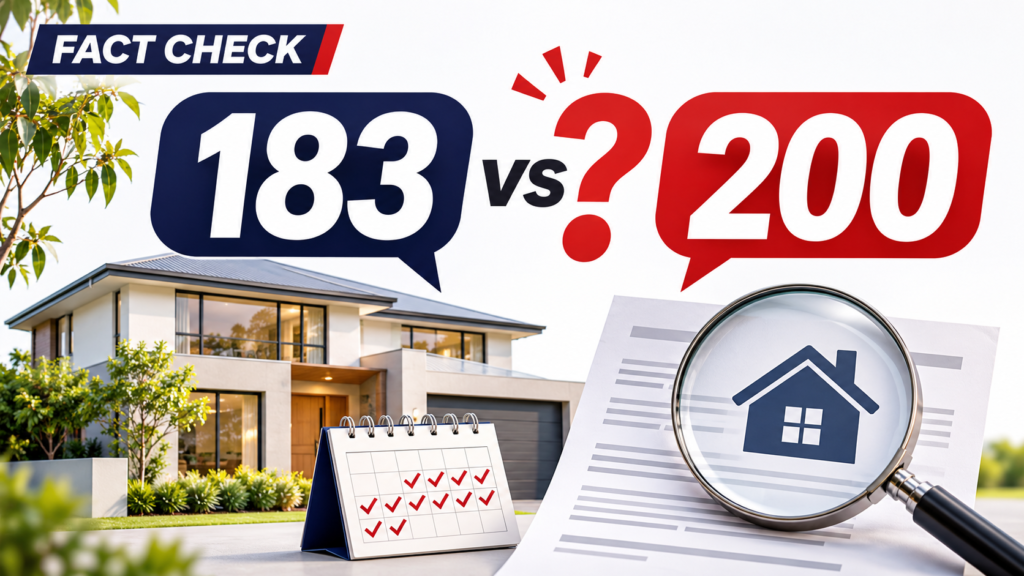
A startling Australian property story has circulated with a familiar formula: two days short, A$160,000 to pay. But what has actually been verified? And why does the reported homeowner talk about 200 days when the Australian Taxation Office (ATO) annual vacancy-fee framework uses a 183-day qualifying residential-use test?
APOA traced the story to James MacSmith’s realestate.com.au report of 20 November 2026, compared a Chinese-language translation and republication, and checked the ATO and Revenue NSW guidance. Our finding: the specific A$160,000 claim remains unverified, and the news coverage risks conflating different residence tests and legal charges.
Where did the headline come from?
The English report relies on a purported Facebook complaint. The person is quoted as saying they believed they had reached 200 days in Australia but were judged two days short and faced a A$160,000 bill. The article presents this as an annual vacancy-fee problem and infers a property value around A$3 million. A Chinese news version credits the English report and repeats the central allegations, while emphasising the alleged owner’s ethnicity and sharply critical online reactions in its headline.
That is not sufficient to verify an individual assessment. At the time of this review, APOA has not been able to examine a complete original social post, an authentic assessment notice, the relevant tax category, the owner’s foreign-investment approval or the underlying date calculations. We are not saying the claimed bill is fabricated. We are saying there is not enough evidence to treat it as a verified vacancy-fee case. The person’s location and identity should not be inferred from commentary or Chinese characters.
183 days and 200 days: two different systems
ATO annual residential vacancy fee — 183 days
For properties within the foreign-investment vacancy-fee framework, the ATO’s test concerns whether a dwelling had at least 183 days of qualifying residential use in its own 12-month vacancy year. That can include genuine owner or relative occupation, qualifying rentals of at least 30 days, or genuine availability for such residential rentals. It is not a universal requirement for the owner personally to sleep there for 183 nights.
Revenue NSW surcharge purchaser duty — some 200-day tests
NSW has separate 200-day rules relevant to certain buyers’ foreign-person status or exemptions from surcharge purchaser duty. One test considers eligible persons’ actual presence in Australia for 200 days in the 12 months before the transaction; another principal-place-of-residence exemption can require 200 continuous days occupying the acquired dwelling after the agreement. Each has distinct conditions.
Revenue NSW expressly says arrival and departure dates count under its pre-transaction 200-day presence test. That does not match the reported social-media assertion that arrival day is excluded. It also does not establish which regime applied to this individual: without the underlying notice, that remains unresolved.
Does a foreign owner have to live in the property for six months?
Not generally under the vacancy-fee rules. The ATO also recognises:
- genuine residential occupation by the owner or a relative;
- genuine occupation by tenants under leases or licences of at least 30 days per qualifying period; and
- genuine public availability on the rental market for residential terms of at least 30 days.
Qualifying periods of at least 30 consecutive days can be combined across the vacancy year. Short stays for less than 30 days do not satisfy the relevant long-term use test. Some established dwellings approved as an owner’s principal residence cannot be rented out under their acquisition conditions, so the approval document still matters.
The claim that all foreign buyers must personally occupy their home for six months every year is therefore an oversimplification that can mislead compliant landlords.
Can a A$160,000 bill prove a A$3 million property value?
No. For vacancy years starting on or after 9 April 2024, the ATO generally calculates the annual vacancy fee as twice the original foreign-investment application fee. That original fee depends on the applicable rules and transaction circumstances, not simply today’s price bands.
In an ATO example for 2026–27, a buyer of a newly developed apartment worth less than A$2 million pays an application fee of A$31,300, making a possible annual vacancy fee A$62,600 if the conditions trigger it. This illustrates the mechanism; it does not validate the reported A$160,000 bill or a A$3 million valuation.
A vacancy fee is a specified statutory charge, not necessarily an administrative “fine”. Separate non-compliance penalties may arise, so that distinction matters too.
Our evidence assessment
- Verified: the ATO’s qualifying 183-day vacancy-fee framework, annual reporting obligation, and doubled fee for the relevant vacancy years.
- Verified: separate NSW surcharge purchaser-duty tests can involve 200 days; for the pre-transaction presence test, entry and exit dates count.
- Unverified: the person’s precise tax liability, the alleged two-day shortfall, the A$160,000 figure, a Sydney location, and the estimated A$3 million property value.
- Misleading without context: statements that every foreign owner must personally live in a dwelling for six months or that the amount of an alleged bill proves the dwelling’s value.
What property owners should actually do
If a dwelling falls within the federal vacancy-fee regime, track its own vacancy year rather than assuming the calendar or financial year applies. The required return is generally due within 30 days of the end of each vacancy year, even if occupancy conditions are met. Missing the return may itself trigger liability. Keep evidence of residential occupation, qualifying leases, genuine rental advertising and any relevant exemptions, and use ATO Online services for foreign investors for lodgment.
APOA editorial note: This is a source-based fact-check, not an accusation that the original English or Chinese report was intentionally false. Translation is not itself the issue. The issue is whether a striking claim is passed along without distinguishing firsthand evidence, media inference and the legal test. Individual liabilities depend on the original documents and professional advice.
Original sources and official guidance
- James MacSmith, Homeowner caught out by annual vacancy fee, realestate.com.au (20 November 2026) — named English news report of the social media allegation.
- Chinese-language compilation at 澳洲印象 — credits the realestate.com.au report.
- ATO: Vacancy fee return for foreign owners — qualifying use, 183 days and returns.
- ATO: Residential fees for a foreign person — fees and worked examples.
- Revenue NSW: Surcharge purchaser duty for individuals — 200-day tests and arrival/departure-day guidance.