
In this article
- 01 | When the unexpected happens
- 02 | Does landlord insurance cover everything?
- 03 | Loss of rent and rent default: what’s the difference?
- 04 | How much cash would you need for six months without rent?
- 05 | Can an insurer keep waiting until the police investigation is over?
- 06 | What happens to the mortgage while you wait for insurance?
- 07 | Does a tenancy agreement continue after a fire?
- 08 | If the insurer approves rebuilding, when can rent resume?
- 09 | Ten questions to check before your next renewal
- 10 | A final thought
- Share your property ownership story
- References
01 | When the unexpected happens
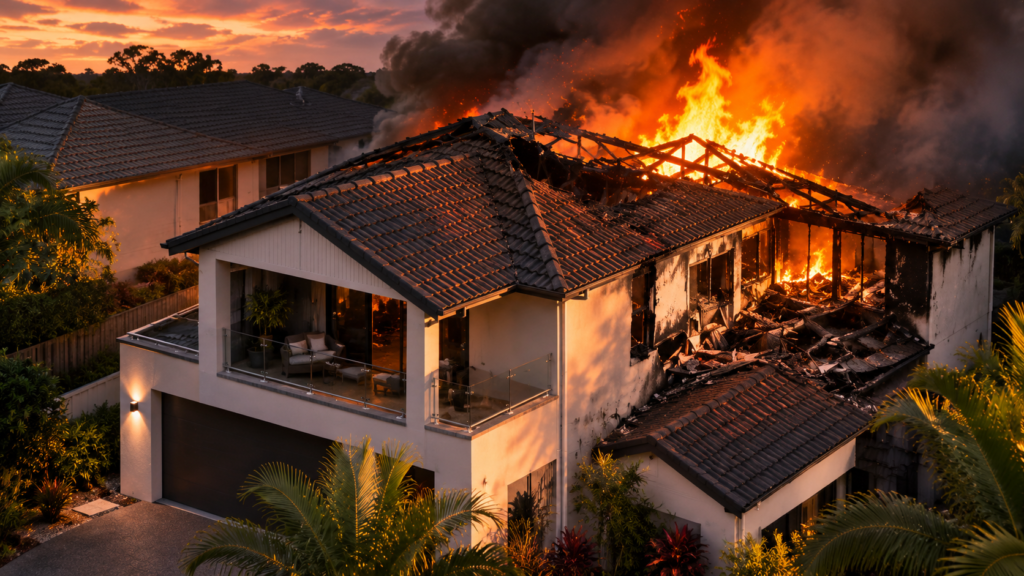
Yesterday, Xiao Wang, APOA’s community editor, received a private message from a reader sharing his story. He sent through television coverage of a house fire and related crime reports. The shocking part? The luxury home shown burning in the news was his investment property in Queensland!
The owner is an experienced bank lending manager and a Justice of the Peace. He is far more familiar with finance, insurance and regulations than the average property owner.
His investment property had enjoyed stable tenants and a very good rental return. Yet even someone with his experience could not have foreseen what happened.
What terrible luck!
The house was destroyed, the rent stopped, but the mortgage repayments continued. With a police investigation involved, the insurance claim has also been taking time to resolve.
His story raises a question worth exploring together: if something like this happens, how much of the loss can the landlord insurance we pay for each year actually cover?
Image: AI-generated editorial illustration inspired by the submitted news screenshots, not a photograph of the actual incident.
02 | Does landlord insurance cover everything?
When the annual renewal notice arrives, many of us look at the premium increase, compare a few quotes online and pay for the policy that seems reasonably priced.
But how many of us have read the policy terms carefully?
A fire can cost an investment property owner much more than the damage to the building itself.
| Loss or expense | Cover or possible response |
|---|---|
| Fire damage to the home | Building insurance |
| Damage to owner-provided furniture and equipment | Landlord contents insurance |
| Property unable to be rented | Loss of rent cover |
| Rent due but unpaid | Rent default cover |
| Mortgage and other ongoing costs | Cash reserves, lender hardship assistance and other options |
Insurers offer different combinations of cover. Two products called landlord insurance can have very different inclusions.
Two documents deserve a close look:
- Policy Schedule: Which covers have you actually purchased?
- Product Disclosure Statement (PDS): When will the insurer pay, how much might it pay, and what is excluded?
Fire, malicious damage and intentional acts may be subject to different definitions, coverage conditions and exclusions. A fire does not automatically guarantee a successful claim.
03 | Loss of rent and rent default: what’s the difference?
Many investment property owners have probably seen both terms in their insurance documents.
Loss of rent
If an insured event such as a covered fire makes a home unfit to be let, an owner may be eligible for compensation for lost rental income during a defined repair or rebuilding period.
Rent default
If a tenant fails to pay rent that is due under their agreement, an owner may be eligible for a payment, subject to the policy conditions.
The two covers address different risks.
For example, one Allianz landlord insurance product offers eligible loss-of-rent cover after an insured event for up to 12 months. Limits, periods and conditions vary across products.
So what happens if it takes 18 months to rent the home again, but your insurance covers only 12 months? Who bears the remaining six months of lost income?
It is worth finding your own policy and checking exactly how long the cover lasts.
04 | How much cash would you need for six months without rent?
Consider a hypothetical ordinary investment property.
| Item | Weekly or monthly amount | Six-month total |
|---|---|---|
| Previous rental income | $700/week | $18,200 |
| Mortgage repayments | $2,800/month | $16,800 |
| Other ongoing holding costs | $300/month | $1,800 |
| Expenses still payable | $18,600 |
All figures are in Australian dollars and are illustrative, not the contributor’s actual financial information.
If rent and insurance payments stop for six months, the owner needs $18,600 in cash just to meet the expenses listed above, before any unexpected additional costs.
For a luxury property, the rent, loan repayments and holding costs could be much higher.
Even if the claim is eventually paid, where will the money come from in the meantime?
This is a risk that many property investors overlook.
05 | Can an insurer keep waiting until the police investigation is over?
This is one of the difficulties our contributor faces.
Where a fire involves a criminal investigation, the insurer may need information from police to establish the cause and assess whether the policy covers the loss.
But needing to investigate does not mean an insurer can leave a customer without updates indefinitely.
Under Australia’s General Insurance Code of Practice, where the Code applies, claims are generally subject to the following timeframes:
| Action | General timeframe |
|---|---|
| Advise what further information is needed | Within 10 business days |
| Provide claim progress updates | At least every 20 business days |
| Respond to routine progress enquiries | Within 10 business days |
| Make a claim decision | Generally within four months, subject to exceptions |
Complex investigations can take longer. A claim exceeding four months is not necessarily a breach of the Code.
Property owners can ask their insurer:
- What information is still outstanding?
- Which parts of the claim have already been assessed?
- Can any part of the claim be paid before the remaining issues are resolved?
- When should I expect the next update?
If communication does not resolve the issue, consider lodging an internal complaint with the insurer and, where eligible, seeking assistance from the Australian Financial Complaints Authority (AFCA).
06 | What happens to the mortgage while you wait for insurance?
The house may have burned down, but the loan agreement does not automatically stop.
If you expect difficulty making repayments, contact your lender’s financial hardship team early. Ask whether temporary reductions, deferrals or other repayment arrangements may be available.
Eligible policyholders can also ask their insurer about expedited claim handling or an advance payment.
A repayment deferral is not a cancellation of the debt and may increase long-term interest costs.
It is better to speak to the lender early than to wait until repayments have already fallen into arrears.
07 | Does a tenancy agreement continue after a fire?
Many property owners may never have considered this question.
Queensland’s Residential Tenancies Authority (RTA) explains that a tenancy agreement does not automatically end simply because the property becomes unliveable.
Depending on the circumstances, a written agreement, a valid notice or an order from QCAT may be necessary.
Where the damage involves a criminal investigation, a breach of the tenancy agreement or other complex circumstances, the applicable legal requirements need further assessment.
Tenancy laws differ between states and territories. Do not assume the procedure in one state applies in another.
08 | If the insurer approves rebuilding, when can rent resume?
Anyone who has built a home in Australia probably knows how much patience construction can require.
Rebuilding after a fire is even more complicated.
Investigation, insurance assessment, structural assessment, demolition, debris removal, design, approvals and construction may all take time.
If an insurer proposes a cash settlement and the owner is responsible for arranging the rebuild, it is important to consider whether the settlement will cover the actual building costs.
The end of a police investigation, receipt of an insurance payment and the day the property can be rented again may be separated by a considerable period.
In the meantime, financial pressures do not simply disappear.
09 | Ten questions to check before your next renewal
- Have the property use and rental arrangements been declared correctly?
- Is the building sum insured sufficient for actual rebuilding costs?
- How are fire, malicious damage and intentional acts covered?
- Are owner-provided furniture, appliances and fixtures insured?
- What is the maximum period of loss-of-rent cover?
- Is rent default covered?
- What excesses apply to different types of claim?
- Are demolition, debris removal and rebuilding compliance costs covered?
- What complaint and support channels are available for complex claims?
- Could my cash reserves cover three, six or even twelve months without rent?
10 | A final thought
We hope our contributor’s situation is resolved as soon as possible, and thank him for sharing his experience with the community.
When discussing investment properties, we often calculate rental yields, capital growth, interest rates and tax benefits. We rarely calculate the cost of unexpected disruption.
If a professional who understands finance, insurance and regulations can face such a difficult situation, what about the rest of us?
Before buying or renewing insurance, rather than comparing premiums alone, ask yourself:
If my property suddenly cannot be rented, what will my policy cover, for how long, and how long can I manage before the claim is paid?
We welcome insights from insurance professionals and anyone who has experience with property insurance claims.
Share your property ownership story
Buying, building, renting, maintaining and managing property in Australia brings plenty of stories: successes, lessons learned, useful knowledge and unanswered questions.
Send Xiao Wang a private message or email the APOA Editorial Team at admin@apoa.org.au.
With the contributor’s permission and appropriate privacy safeguards, we will turn useful experiences into articles that other property owners can learn from.
One person’s experience can become a lesson for the whole community.
References
- ASIC MoneySmart — Choosing home insurance
- ASIC MoneySmart — How to make a home insurance claim
- Insurance Council of Australia — General Insurance Code of Practice
- Insurance Council of Australia — Urgent financial assistance under your policy
- ASIC MoneySmart — Problems paying your mortgage
- Queensland RTA — Property becomes unliveable
- AFCA — Insurance complaints
- Allianz — Landlord insurance (product example)
To protect the privacy of the contributor and others involved, we do not publish the property address or links to the original news footage. This article is general educational information, not individual legal, insurance or financial advice, and does not endorse any particular insurance product.