
Everyone Recommended Kunge. What Else Happened in APOA This October?
APOA Australian Property Owners Alliance | October 2026 Community Newsletter
1–31 October 2026 | 31 days · 12 archived community-group sources · 9,703 identifiable October messages
Editor's Note | Never a Dull Month in the APOA Community
Melbourne was beginning to feel a little like summer in October. And judging by the conversations in APOA's WeChat groups, things were heating up in more ways than one.
It started with a perfectly ordinary request: a member wanted to help an overseas friend find a real estate agent to sell an apartment. Before long, the discussion had turned into an enthusiastic round of recommendations for Kunge.
There was just one problem. Kunge himself was nowhere to be seen.
When he finally appeared hours later, his explanation was wonderfully simple: he'd been in class and hadn't seen any of it.
Meanwhile, a five-bedroom rental property had somehow acquired ten beds. A blocked drain attracted a plumbing quote of $2,500 before the exact blockage had even been identified. Foxes were turning up in backyards, possums were settling into roof spaces, and even the humble showerhead had become a subject of regulatory debate.
Who said property ownership was boring?
But October was about much more than unexpected repair bills and unusual rental stories.
APOA held an important community policy forum in the Box Hill area. Members in Sydney enjoyed their first face-to-face gathering. And the community that many of us had long known as the Australian landlords' WeChat groups took another step towards embracing its wider identity: the Australian Property Owners Alliance.
With Victoria's state election approaching, land tax, rental regulations and housing policy were never far from the conversation either.
Across 31 days and 12 community-group sources, 9,703 October messages can be identified by their timestamps. The old archive header's figure of 31,053 counted text lines, including sender names, timestamps and multiline message content; it was not a count of WeChat messages.
Here are the people, stories and conversations that made October memorable.
Chapter One | A Name That Finally Fits
There was something worth marking in APOA's history this October.
The community many of us have known for years as the Australian landlords' WeChat groups began formally bringing its Chinese identity into line with a much broader vision: a community for all property owners.
In fact, APOA has always stood for the Australian Property Owners Alliance.
The organisation's English name was never limited to landlords.
Our community grew out of the landlords' groups started by Kunge, where members came together to ask questions about renting out property, managing tenants and navigating the endless practicalities of being a landlord in Australia.
Over the years, however, something interesting happened.
The conversations started reaching well beyond rental properties.
One member had just purchased a first home and wanted renovation advice. Another was considering selling an investment property. Others were discussing insurance, land tax, granny flats, mortgage costs, retirement planning and how best to look after the family home.
And if October's conversations were anything to go by, property owners have plenty in common regardless of whether they live in their homes or rent them out.
Solar panels, draughty windows, smoke alarms, overhanging trees, unexpected repair bills and even foxes under the house are hardly landlord-only problems.
So this wasn't really about changing what APOA stood for. It was about bringing the Chinese community name into line with what the community had already become.
A broader name, the same community spirit
APOA's community roots go back to around 2020. The organisation was formally registered in 2024 as a not-for-profit.
Since then, informal conversations have gradually grown into community events, educational sessions, public forums, newsletters and an expanding collection of practical information on the APOA website.
In October, APOA continued updating its organisational profile, public-facing information and plans for 2027.
Three connected priorities now help describe where we are heading:
Member Support · Knowledge & Education · Policy & Advocacy
Those words may sound rather formal. But they don't mean our WeChat groups are about to become endless committee meetings.
People will still compare repair quotes, share rental experiences, debate the property market and occasionally get carried away discussing an unusually expensive plumbing job.
We want to keep the friendly, practical atmosphere that made the original groups valuable.
The difference is that we also want to preserve useful experiences as knowledge that others can find, learn from and share.
October brought another small milestone: the APOA Mid-Autumn Gala and Annual Meeting, held in September, received coverage on the 3ZZZ FM 92.3 Mandarin program on 1 October.
From group chats to a website, community activities and public conversations, APOA is gradually finding its own way forward.
Our roots remain in the original landlords' community. Our branches now reach towards a much wider group of Australian property owners.
Chapter Two | October in Action: Box Hill and Sydney
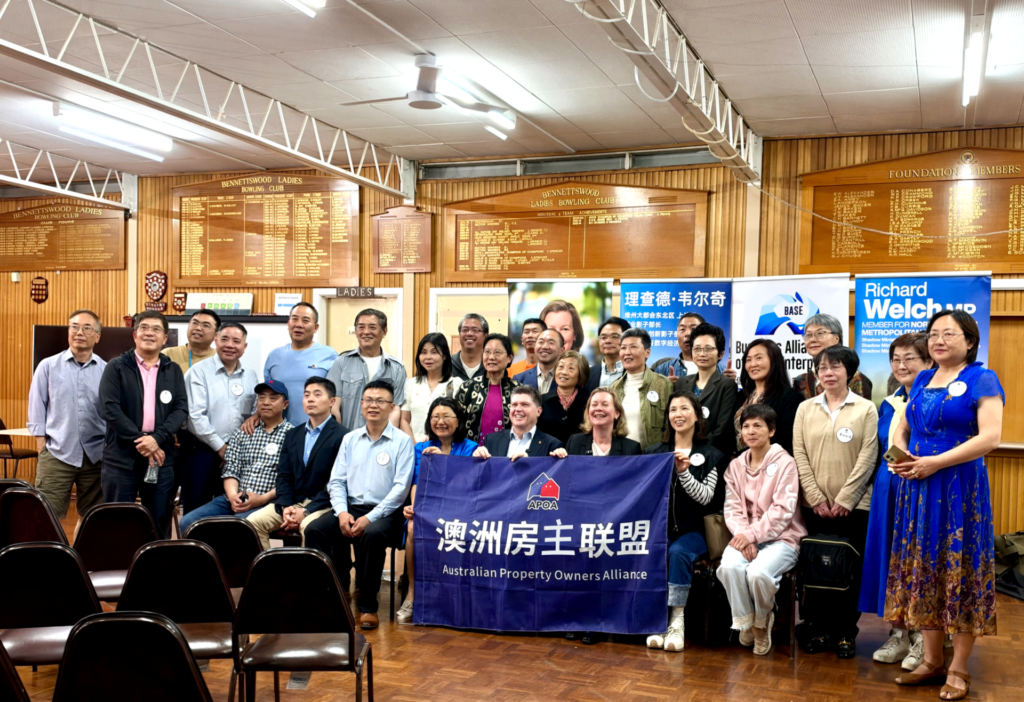
Box Hill: A major community forum comes together in just a few busy days
With Victoria's state election approaching, the conversation in our groups had become increasingly focused on politics and public policy.
Land tax. Rental minimum standards. Housing development. Community safety. Transport. The cost of living.
Members had been discussing many of these issues for months.
At some point, the obvious question arose: why not take those concerns directly to people involved in public policy?
On the evening of 24 October, APOA held a community policy forum at Bennettswood Bowls Club in Burwood.
The event brought together local residents, Liberal Party candidate for Box Hill Sally Houguet, and Victorian Legislative Council member Richard Welch MP.
It wasn't simply a night of speeches.
APOA had gathered questions from its community in advance, allowing issues raised in everyday WeChat conversations to become part of the forum's agenda.
Residents asked about property taxes, housing, transport, public services and the pressures facing families and businesses.
A little technology, and a hands-on voting lesson
One of the forum's most interesting features was the use of AI-assisted live interpretation and transcription.
Chinese and English text appeared on a large screen, helping people with different language backgrounds follow the discussion and take part.
AI interpretation is not perfect, particularly when complicated policy terms are involved. But this was a practical example of technology making community participation more accessible.
There was also a mock voting exercise prepared by David Chu from BASE.
Participants tried filling in sample ballots and learned how preferential voting works in elections for Victoria's Legislative Assembly.
For anyone who has ever looked at a ballot paper and wondered what all those numbered preferences actually do, a hands-on demonstration can make a real difference.
The work behind the evening
The forum came together through a short period of intensive preparation.
Kunge took a leading role in planning and coordination, working alongside APOA volunteers and members of BASE who contributed organisational and practical support.
Volunteers helped with arrangements, technology, photography and activities on the night.
Garry, whose usual work is as a handyman, decided to try his hand at event photography.
It's a small detail, but a lovely illustration of what volunteering can be: people bringing their existing skills, and sometimes discovering new ones along the way.
For APOA, the significance of the Box Hill forum was simple. Questions that had been circulating in community conversations were brought into a public, face-to-face discussion.
As an independent not-for-profit organisation, APOA welcomes constructive discussion of housing and community policy. Hosting an event with political representatives does not amount to endorsing a political party.
We've published a separate feature covering the questions, discussions, photographs, AI interpretation and mock voting activity.
Read the full Box Hill Community Policy Forum feature
And a quick hello from Sydney
The following day, 25 October, around twenty APOA members and friends enjoyed the Sydney community's first in-person picnic at the Royal Botanic Garden. Jenni organised the gathering, and Kunge paid his own airfare to travel from Melbourne in support. For friends who had mostly known one another through WeChat, it was a lovely chance to finally meet in person.
Chapter Three | A Reputation Earned: Kunge Is October's Community Star
On 30 October, a very ordinary question in APOA's Melbourne Group 8 turned into one of the month's most heartwarming conversations.
At around 11:30 in the morning, Maggie posted a request.
A friend of hers, living overseas, owned an apartment near Melbourne's CBD. The holding costs had become difficult to justify, and the owner was considering selling.
Could anyone recommend a reliable real estate agent?
It was exactly the sort of question people ask in a property owners' group.
One member promptly suggested an agent they knew. Maggie thanked them.
That could easily have been the end of the conversation.
But a few hours later, other members joined in.
"Why not ask Kunge?"
Then came more recommendations.
One member said they had entrusted their rental property to Kunge's business and appreciated his conscientious approach.
Others pointed to the amount of time he had spent helping the community over the years.
Someone joked that he was so low-key that even long-standing members weren't entirely sure what services his business offered.
Before long, Maggie's simple request had become an impromptu round of glowing recommendations.
Meanwhile, the man himself was nowhere to be seen
Maggie found the whole thing rather amusing.
Later that afternoon, she responded along the lines of:
"My question has brought Kunge a whole wave of glowing reviews! 👍 I honestly thought he only managed rental properties."
She decided to contact him privately.
And where was Kunge while all this was happening?
He finally appeared after four in the afternoon.
"Thanks, everyone. I was in class and hadn't seen the messages."
Well, that explained the silence. 😂
The group had spent a good part of the afternoon recommending him, while the man himself was simply getting on with his day.
Of course, the member who initially recommended another agent had been trying to help too.
APOA should always remain a place where people can share different experiences and recommendations, and where members are free to compare services and make their own decisions.
What made this story special was something else.
Someone who had spent years contributing to the community found that, when a member needed help, others were willing to speak positively about him without being asked.
Why Kunge?
Kunge works in real estate, but regular members know that he rarely uses the community groups to promote his own business.
Instead, he has spent years making and sharing property-related videos, often almost every week.
He discusses rental management, market developments, policy changes and the everyday problems property owners face.
He also regularly joins group conversations when members are looking for practical guidance.
And October was a particularly busy month.
He devoted considerable time to helping organise the Box Hill policy forum, then paid his own way to Sydney to support the community's first gathering there.
None of this happens without effort.
Everyone has work, family commitments and their own responsibilities. Finding time to contribute to a community consistently over several years is no small thing.
🌟 APOA October 2026 Community Star: Kunge
This month, we are delighted to recognise Kunge as APOA's October Community Star.
It's our way of saying thank you for his sustained educational videos, practical support for fellow members and contributions to the Box Hill and Sydney activities.
This recognition is about volunteering and community service, not an endorsement of any particular real estate agency or commercial service.
We also thank everyone who shares advice, answers questions, helps organise activities or simply takes the time to lend a hand.
That lively recommendation thread on 30 October left us with a rather nice reminder:
A good reputation isn't built by telling everyone how good you are. It's built when other people remember you when someone needs help.
A well-deserved round of applause for Kunge! 👏
Chapter Four | Tales from the Property Owners' World
After all that community activity, it's time for the stories that remind us why property ownership can be such an adventure.
October certainly provided plenty of material.
Case One | Five bedrooms. Ten beds. One worried landlord.
Early in October, a rental property owner raised a question that immediately got everyone's attention.
The house had five bedrooms.
But a recent inspection report showed ten beds.
Most were single beds, with a few doubles.
Rent was being paid, and the property was under professional management. But the owner understandably wanted to know what was happening.
How many people were actually living there? Was there any unauthorised subletting? Could the way the property was being used affect safety requirements, insurance or maintenance?
Members offered different perspectives.
Some pointed out that the presence of ten beds doesn't necessarily mean ten people live in the property. Others suggested checking the lease, inspection records and actual occupancy arrangements.
That distinction matters.
The number of beds alone does not establish that anyone has broken the law or breached a lease.
But when a property inspection raises legitimate questions, owners can seek clarification from their property manager, document their concerns and follow the appropriate legal process.
The real worry behind those ten beds was something larger: how much does a property owner actually know about the use of a property after handing over the keys?
Case Two | A blocked drain and a $2,500 quote
On the afternoon of 30 October, another member of Melbourne Group 8 had a plumbing problem.
Whenever the kitchen tap ran, wastewater began rising through the downstairs shower drain.
Leave the water alone for an hour or two, and it would slowly disappear again.
The owner tried baking soda and vinegar, then purchased a drain-clearing tool from Bunnings.
No luck.
Eventually, a plumber came out.
The proposed job involved removing the toilet and using professional drain-clearing equipment.
The quote?
$2,500.
The owner asked whether the job could be done for $2,000. The plumber declined.
But the price wasn't the only concern.
The precise location of the blockage hadn't yet been identified, the outdoor inspection point couldn't be found, and a CCTV drain inspection would cost extra.
The owner decided not to proceed immediately and arranged for another plumber to investigate.
Naturally, the group had plenty of suggestions.
Kunge encouraged getting the inspection and repair scope clarified and comparing the charges.
Then the conversation took a turn that nobody could have predicted.
One member joked about sending a rat down the pipe.
Another suggested a catfish.
The owner joined in: where exactly was he supposed to catch a rat? 😂
The drain remained blocked, but the conversation was flowing beautifully.
For the record, please don't put animals down pipes or experiment with hazardous drain-clearing methods.
The practical lesson is worth keeping: when a drainage problem hasn't been clearly diagnosed, ask what the inspection covers, what work is proposed and how the quote has been calculated. Wastewater backing up into living spaces is a job for an appropriately qualified professional.
Case Three | A trip to the airport, with an unexpected fine
Melbourne Airport's changing pick-up arrangements gave several members something else to discuss.
A familiar airport journey became rather less familiar when routes, waiting areas and parking restrictions changed.
One member shared an experience of receiving a fine while collecting someone from the airport.
That prompted a round of practical advice about terminal pick-up zones, stopping restrictions and the importance of checking current directions.
The lesson was straightforward: at a busy airport, yesterday's routine may not be today's permitted route.
Case Four | When workers paid to fix a pothole themselves
A video about workers buying approximately $500 worth of materials to repair a damaged road also caught the group's attention.
Members discussed the costs of public maintenance, the speed of road repairs and the difference between an improvised fix and a properly managed infrastructure project.
Of course, a few hundred dollars in materials cannot be compared directly with the total cost of an authorised road repair, including traffic management, labour, safety and liability.
Still, the underlying question resonated with residents:
When a road is visibly damaged, how quickly should the community reasonably expect it to be repaired?
Case Five | Foxes in the garden, possums in the roof
Wildlife joined the conversation towards the end of October.
Members of Melbourne Group 6 discussed foxes appearing in suburban backyards and potentially getting beneath houses.
People with pest-management experience shared suggestions about food sources, access points and physical barriers.
Then the conversation moved to possums.
Unlike foxes, possums are native protected wildlife, and their removal or relocation is subject to specific legal restrictions.
Property owners may need specialist assistance rather than attempting to deal with the animals themselves.
Managing a home in Australia sometimes means becoming unexpectedly familiar with local ecology.
Case Six | A carport crosses the boundary
Another discussion at the end of the month concerned a carport that allegedly extended beyond a property boundary.
Even a small encroachment can raise difficult questions involving land surveys, title documents, building approvals and neighbour relationships.
A fence line is not necessarily the legal property boundary.
The discussion also revived interest in title insurance and the importance of checking property documentation before building or buying.
Some property problems are hidden behind the walls.
Others are hiding in decades-old survey plans.
Chapter Five | Lessons Worth Sharing: October's Practical Property Toolkit
Not every useful conversation makes a dramatic story.
Some of the best advice shared in the APOA community is about the little things that can save someone money, time or a great deal of frustration.
Here are a few topics worth keeping from October.
Solar installed, but where are the feed-in credits?
On 24 October, members discussed cases where a solar installation appeared to be working but its grid connection, metering or account arrangements had not been completed as expected.
In some situations, problems only came to light when owners later considered adding a home battery.
The lesson: having equipment on the roof does not necessarily mean every administrative and technical step is complete.
Connection approvals, metering, electricity retailer settings and feed-in arrangements all deserve a final check.
Battery capacity prompted another useful debate. A system that works well for one household may not suit a family with heavy overnight heating demand.
Battery size, electricity tariffs, installation costs and actual energy use all matter.
Since when did a showerhead need a star rating?
Members shopping at Bunnings noticed that showerheads with similar appearances could have different WELS water-efficiency ratings.
With Victorian rental property standards and future efficiency requirements under discussion, owners wanted to know which products would be suitable.
And what if the showerhead was installed years ago and its packaging had long since disappeared?
Keeping model numbers, receipts and product specifications can make future verification easier.
The precise standard, commencement date and any transitional arrangements must still be checked against official Victorian requirements.
That smoke alarm keeps chirping
Intermittent beeping from a hardwired smoke alarm was another practical topic.
Low backup batteries, dust, device age or faults may all require investigation.
Electrical work involving hardwired devices should be handled by appropriately qualified people.
Home security alarms can pose a different puzzle: the keypad may show a low-battery warning, while the backup battery is located inside the main control unit.
Two similar-sounding alarms can have very different maintenance requirements.
The garage remote has disappeared
What happens when a tenant moves out and a garage door remote is missing?
Members discussed checking the motor's make and model, locating compatible remotes and arranging reprogramming.
Replacing the whole garage-door system is not always necessary.
But if an old remote may still be in someone else's possession, owners should also consider whether its access needs to be disabled.
Twelve years of property ownership: was it worth it?
Early in October, a member reflected on an investment property held for twelve years.
Rental income had changed over time, but so had interest costs, maintenance, taxes, insurance and vacancy expenses.
Selling raised one set of questions.
Continuing to hold the property raised another.
Other conversations covered council rates, emergency-service-related levies, depreciation schedules and the potential costs and benefits of granny flats.
The recurring lesson was simple:
The purchase price is only the beginning. What matters over time is the full financial picture.
APOA will continue turning these practical discussions into accessible stories and reference material through the newsletter and Community Wall.
Chapter Six | Election Season: Land Tax, Rental Rules and Big Questions
Victoria's state election is scheduled for 28 November, so it's no surprise that policy discussions featured prominently throughout October.
For property owners, election announcements often translate into very practical questions.
How much will a property cost to hold? What improvements might landlords be required to make? How will housing policies affect the rental market?
Tax relief sounds good. But who actually qualifies?
Members discussed land-tax announcements and proposals associated with Victoria's Labor government and the Liberal opposition.
Some welcomed the possibility of lower holding costs. Others were cautious about promises made during an election campaign.
The most useful questions were about the details.
Which owners or properties would qualify? When would any changes take effect? Would there be eligibility conditions? Could a measure aimed at a specific housing project be mistaken for broader relief available to ordinary investors?
A headline about land-tax relief doesn't tell the whole story.
The details matter.
Minimum rental standards: a growing checklist
Members continued comparing notes on draught-proofing, water efficiency, heating and cooling, smoke alarms and safety inspections.
Most people agreed on the importance of safe, comfortable rental housing.
The practical debate was about understanding requirements, planning works properly and managing costs.
With some measures involving future commencement dates or transitional conditions, owners should distinguish current obligations from proposed or upcoming changes.
Community discussions are a useful starting point, but official guidance and appropriate professional advice remain essential.
A proposed landlord licensing scheme raises new questions
A landlord licensing proposal discussed by the Victorian Greens also generated interest.
Some members were concerned about potential administrative costs and additional compliance obligations.
Others focused on the question of how serious or repeated breaches should be addressed and how the rights of renters and rental providers might be protected.
It is important to distinguish a party proposal from legislation already in force.
APOA's role is to help members understand public-policy debates and share practical experiences, not to make political choices on their behalf.
Understanding how voting actually works
Later in the month, Kunge shared a video discussing Victoria's preferential voting system.
For people unfamiliar with the process, learning how preferences are marked and counted can be more useful than simply reading campaign slogans.
Voters should always consult the Victorian Electoral Commission for the official instructions applying to the current election.
October's political conversations were lively, and they certainly weren't unanimous.
That's fine.
A healthy community can accommodate different political views while making room for facts, thoughtful questions and respectful discussion.
Chapter Seven | Building Towards 2027: More Neighbours, More Ideas, More Volunteers
As APOA embraces its identity as a community for all Australian property owners, we are also looking towards the next stage of its development.
Over the years, our members have shared an extraordinary variety of experiences.
Some know rental management inside out. Others understand plumbing, building, insurance, taxation or legal processes.
Some are excellent organisers. Some enjoy photography or video editing. Others simply have a useful story to tell.
No single person needs to know everything.
A community becomes stronger when its members are willing to share what they know.
Invite a friend to APOA
Whether someone has just bought their first home, owns an investment property, is considering selling or is planning for retirement, there may be something useful for them here.
We warmly welcome members to introduce friends who could benefit from APOA's community and knowledge-sharing activities.
Our goal for 2027 isn't simply to have more names on a membership list.
It's to create more opportunities for people to connect, learn and help one another.
Have an idea? We'd love to hear it.
Could we organise a hands-on DIY home maintenance workshop?
What about sessions on title insurance, property and retirement planning, or common rental-management problems?
Would members enjoy more local gatherings, expert Q&As or property-knowledge challenges?
Could volunteers help turn real community experiences into illustrated articles, useful videos or short educational guides?
Good ideas don't need to arrive as fully developed project plans.
And suggesting something doesn't mean having to organise it all yourself.
Sometimes the first step is simply to share an idea and see who else is interested.
🌱 Volunteer with APOA: A little time can make a real difference
The Box Hill forum showed what a small group of motivated volunteers can accomplish together.
As we look towards 2027, APOA would love to hear from people interested in contributing to community activities and content.
We particularly welcome help with:
- Photography and visual content: taking event photos and sourcing images that can legally be used in articles.
- AI-assisted illustrations and design: creating simple diagrams, editorial illustrations and useful visual explanations.
- Writing, translation and fact-checking: helping make community stories clear, accurate and accessible in Chinese and English.
- Video, website work and events: supporting educational content, online publishing and community gatherings.
Volunteering does not have to mean a weekly commitment or responsibility for an entire project.
One person might help with a few photographs. Another might check a technical detail. Someone else might lend a hand at a weekend event.
Every contribution matters.
We want APOA to be a welcoming place to volunteer, not a second full-time job. 😄
In 2027, we hope more people will join us—not only to receive information, but to share experiences, contribute ideas and help build the community together.
Join APOA · Volunteer · Support APOA
Chapter Eight | Kunge on Camera: October's Video Picks
A monthly APOA newsletter wouldn't be complete without one of our regular favourites: Kunge's videos.
Over the years, Kunge has continued producing explainers and commentary on property management, rental policy, market developments and other issues affecting property owners.
Sometimes a short, well-structured video can make a complicated discussion much easier to follow.
Here are three October topics worth revisiting.
🎬 If a Landlord Loses Their Licence, Who Pays the Mortgage?

A discussion of the proposed Victorian landlord licensing scheme and the questions it raises about mortgage payments, land tax and other holding costs.
This is a discussion of a policy proposal, not a statement that such a licensing scheme has already become law.
🎬 Will Renters Be Able to Check a Landlord's History?

An exploration of rental regulation, information records and the rights and responsibilities of renters and property providers.
🎬 Australian Mortgage Rates Once Reached 17%!

A look back at a very different interest-rate environment, and a reminder that Australian property owners have navigated a wide range of market conditions over the decades.
You can find more videos here:
And if you enjoy Kunge's videos, don't forget to share them or suggest a question for a future episode.
He's already our October Community Star. We might as well keep him busy. 😄
Until Next Month | The Stories Keep Coming
October is over, but the stories certainly aren't.
APOA has taken another step towards embracing its broader identity as the Australian Property Owners Alliance.
The Box Hill forum brought community questions into a public discussion. Sydney members finally met in person. And Maggie's search for a real estate agent turned into an unexpected celebration of Kunge's contributions.
Somewhere, the mystery of the ten beds still needs sorting out.
A blocked drain is waiting for another plumber.
The fox may still be visiting the backyard.
And someone is probably looking at an electricity bill, wondering whether a bigger solar battery would help.
That's everyday life for Australian property owners: a little complicated, sometimes frustrating, and occasionally very funny.
With Victoria's election approaching in November and APOA preparing for 2027, there will be plenty more to discuss.
Homes come in different shapes and sizes. So do the people who own them.
But when we share our experiences, we make it a little easier for the next person facing the same problem.
The best thing about this community isn't that everyone knows everything. It's that something you know today might be exactly what someone else needs tomorrow.
See you in the next issue.
Australian Property Owners Alliance (APOA)
Connect · Share · Make a Difference
Editorial note: Community experiences have been edited for readability and privacy. The monthly message count follows the archive's reporting method. Individual stories and community discussions are shared for general information and should not be taken as legal, financial or professional advice.