
In this article
Adapted from a real Victorian homeowner case first published in the APOA Community Library on 7 November 2026.
Some home maintenance problems begin not with a leak or a bill, but with a window suddenly covered in bees. Should you spray them, seal the gap, or call someone?
Before taking action, the important question is whether the bees are temporarily resting or already occupying a cavity in the building.
Case photograph (dense cluster warning) — click to reveal
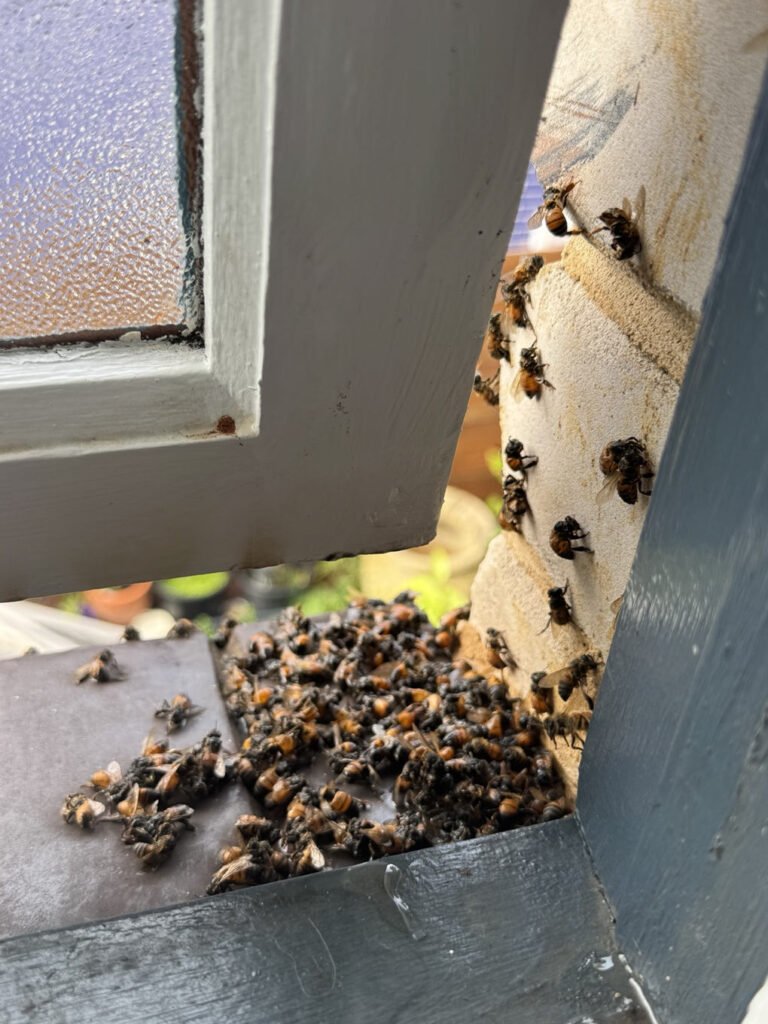
01 | A passing swarm or an established hive?
In Victoria during spring and summer, honey bees may swarm as part of their natural reproductive cycle. A cluster resting on a branch, fence or under an eave may simply be waiting while scout bees locate a new home.
Another possibility is an established colony inside a wall, roof space or cavity near a window frame. If bees repeatedly enter and leave the same gap over several days, especially if persistent buzzing is heard inside the wall, seek professional assessment.
A photograph of a cluster by a window does not prove there is a hive inside the wall. An on-site assessment is needed.
02 | Do not spray the bees or seal the opening
Bees may defend themselves if disturbed. Spraying household insecticide, throwing water, striking the cluster or poking inside a gap can increase the risk of stings.
- Keep children, other household members and pets away from the cluster and its flight path.
- Close nearby windows where this can be done safely. Do not lean outside to take a close-up photograph.
- Do not dismantle window frames or seal an active entrance before a professional assessment.
- Take a photograph from a safe distance and record when and where the bees are active.
Blocking a visible hole does not mean the bees inside are gone. Have the colony assessed and dealt with first; a professional can then advise on removing residual comb and repairing gaps.
03 | A beekeeper or a pest controller?
For a temporary, accessible swarm on a branch or fence, contact a beekeeper, apiarist or swarm catcher to ask whether collection and relocation is possible. Not every situation is suitable for live relocation.
Bees established inside walls, window frames or eaves may require an experienced pest controller or a beekeeper who specialises in removing colonies from buildings. Knox City Council distinguishes exposed swarms from concealed nests.
Treatment, relocation, removal and chemical treatment are not interchangeable terms. Ask exactly what will happen to the bees and any comb.
If the property is part of an owners corporation, notify the strata or owners corporation manager to clarify responsibility and approvals for exterior walls, window frames and common property. The location alone does not determine who is responsible.
04 | Five questions to ask the professional
- Is this a temporary swarm or an established colony in the building cavity?
- Can the bees be collected or relocated? If not, why?
- What does the quote cover: inspection, treatment, access, comb removal and repairs?
- When will the site be checked again, and whom should I contact if bee activity continues?
- Once the colony has been dealt with, which gaps need repair and who will arrange it?
Some services address only the immediate bee activity. Access, cleaning, repairs and sealing may be separate work. Confirm what is included before authorising or paying for a service.
05 | Bee stings: when is it an emergency?
A typical bee sting may cause local pain, redness and swelling. If a stinger remains, remove it promptly, wash the area and apply a cold compress. Difficulty breathing, swelling of the tongue or throat, voice changes, persistent dizziness or collapse can indicate anaphylaxis.
Suspected anaphylaxis is an emergency: call 000. Give an adrenaline autoinjector promptly if available and indicated by the person’s emergency plan. Lay the person flat and do not allow them to stand or walk. If breathing is difficult, follow first-aid guidance and the emergency operator’s instructions on positioning.
Seek immediate medical help for a sting inside the mouth or multiple stings. See the Victorian Better Health Channel guidance below for details. This is general first-aid information, not a substitute for medical assessment.
06 | After the bees have gone
- Ask the professional whether entrances remain active and whether concealed comb or residue needs inspection or removal.
- Once the colony has been dealt with and the area is safe, arrange suitable repairs. Do not indiscriminately seal openings intended for ventilation or drainage.
- Keep the photographs, quote, service details and follow-up records. If common property is involved, provide these to the owners corporation manager.
Good home maintenance is not only about finding someone when a problem occurs. It is also about completing the inspection, coordination, repair and follow-up. Identify the issue, find the right professional and check what happens afterwards.
For a related story about misunderstanding the name of a pest control company, see the APOA Community Library case study on AI and context (Chinese).
References and further reading
The original library article records its source check on 7 November 2026. Council responsibilities and services may vary by location. This is a case-based learning article, not an official translation.
- City of Casey — Bees and wasps
- Knox City Council — Pest animals and insects
- Agriculture Victoria — Beekeeping for beginners
- Better Health Channel — Bites and stings – first aid
- Better Health Channel — Anaphylaxis
- Boroondara City Council — Bees and wasps
General information only; not professional pest control, building, legal or medical advice. The case photograph does not establish insect identity or nest location. In an emergency, call 000.
中文版 · Original Community Library article (Chinese) · Related: mould in a rental shower