
In this article
A rental statement is more than confirmation that money has reached your bank account. It helps property owners check how much rent was received, what the agent deducted, and how much was paid to the owner. But it may not tell the complete story of whether the renter is in arrears.
Start with a sample rental statement
This is a fictional educational example, not a real statement. Imagine a Victorian rental property with monthly rent of A$3,200. The example statement is dated 8 November 2026 and shows Rent Paid To: 30 November 2026.
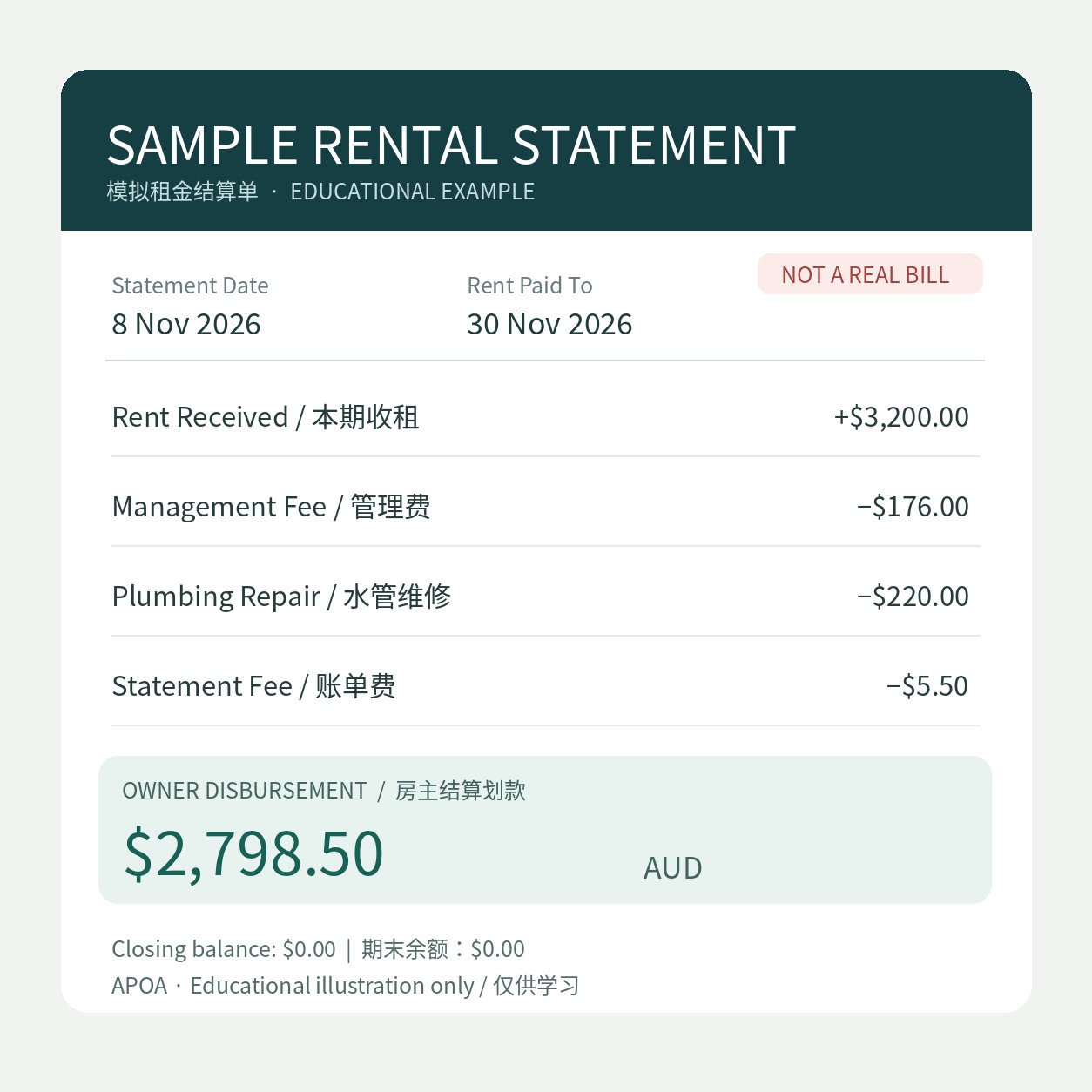
| Statement item (example) | Amount (AUD) |
|---|---|
| Opening Balance | $0.00 |
| Rent Received | +$3,200.00 |
| Management Fee | −$176.00 |
| Plumbing Repair | −$220.00 |
| Statement Fee | −$5.50 |
| Owner Disbursement | −$2,798.50 |
| Closing Balance | $0.00 |
Here, $3,200 − $176 − $220 − $5.50 = $2,798.50 is the owner’s disbursement. The transfer is shown as money leaving the agency trust account; it is the amount intended for the owner. This is not the property’s final profit: mortgage repayments, insurance, council rates, owners corporation costs and other expenses may be paid separately.
Know the language on your statement
| Term | What to look for |
|---|---|
| Statement Date / Number | The statement’s date and reference |
| Rent Received / Money In | Rent or other funds recorded in this period |
| Rent Paid To | The rental period paid up to — not your bank credit date |
| Management Fee | Agency fee under the management authority |
| Other Expenses / Money Out | Repairs, bills or other payments made on the owner’s behalf |
| Owner Disbursement / EFT | Amount the agent has sent to the owner |
| Balance Brought Forward | Balance carried from a previous statement |
| Balance Remaining | Residual balance on this statement; not a direct measure of rent arrears |
| Arrears | Rent that is due but unpaid |
Two common misunderstandings
Rent Paid To is not the date you received the rent. It identifies the date up to which rent has been paid. The tenant may have paid earlier, and the property manager might transfer funds on a separate schedule.
A zero Balance Remaining does not automatically mean the tenant is up to date. It usually describes the balance left after transactions in that accounting period. To assess missed rent, compare the Rental Ledger against the rental agreement and payment due dates.
Fees, GST and a $176 management charge
The agency’s fees should match the written management authority. Consumer Affairs Victoria says fees and expenses can be negotiated and the contract should set out who pays them, including GST obligations.
In our example, a 5% management fee plus GST on $3,200 gives $160 plus $16 GST = $176. If 5% was inclusive of GST, the calculation would be different. A GST Summary on a statement may summarise GST already included in service fees, not an additional deduction.
Ordinary long-term residential rent is generally an input-taxed supply for GST purposes. That is different from taxable agency management services. See the ATO’s residential rental GST guidance for the applicable treatment.
Owner statement vs rental ledger vs bank record
- Rental/Owner Statement: receipts, deductions and the agency’s disbursement for a period.
- Rental Ledger: when the renter paid, the period covered and any unpaid amounts.
- Bank Statement: whether, when and how much the owner actually received.
If a payment seems late, ask: Has the agency received rent? What is the current Rent Paid To date? When was the owner disbursement initiated? Ask for the relevant ledger or expense invoices where needed. A delayed bank credit alone does not establish that the tenant is in arrears.
What about tax? Gross rent and net transfer are different
The Australian Taxation Office explains rental income that owners must declare, including rent collected by property managers. Management charges and other eligible deductions are accounted for separately under tax rules; the net cash transferred is not necessarily the gross rental income to declare.
A one-minute check for every statement
- How much rent was received, and what rental period does it cover?
- Which fees and other expenses were deducted, and are they supported by the authority or an invoice?
- How much was transferred to me, and on what date?
- Do the statement, rental ledger and bank credit reconcile?
Related: Tenant Paid Rent, but You Haven’t Received It? Rental Cash Flow Explained.
Official references
- Consumer Affairs Victoria — Using a property manager or real estate agent
- Consumer Affairs Victoria — Accounting for trust money
- Consumer Affairs Victoria — Rent payments and rent in advance
- Consumer Affairs Victoria — Late or unpaid rent
- ATO — Rental income you must declare
- ATO — GST on residential rent and bonds
- APOA Community Library — How to Read a Rental Statement (Chinese source)
Sources checked 11 November 2026. This is general property-owner education, not individual legal, financial or tax advice. The sample statement, figures and dates are fictional and do not describe any real property or transaction.