
Key takeaways
- A fence line does not necessarily mark the legal title boundary.
- A known encroachment is not necessarily covered by a newly purchased policy.
- Title insurance does not replace a professional land survey.
- A real claim: 3.2 square metres and more than $7,000 in compensation
- Does the fence mark the legal boundary?
- What is title insurance?
- Why is title insurance different from ordinary insurance?
- What if an encroachment is already known?
- Can title insurance replace a boundary survey?
- Can existing homeowners purchase title insurance?
- What should you do if you discover a boundary problem?
- Five questions to ask before buying property
- From community experience to practical property knowledge
APOA Community Knowledge | Property Rights · Boundary Disputes · Risk Management
A discussion among APOA community members about a misplaced boundary fence raised an important question: could title insurance help if a property owner discovers that part of their land has been lost?
In October 2026, a conversation in the Australian Property Owners Alliance (APOA) community began with a familiar concern: what happens when a fence does not follow the legal property boundary?
One member shared information about title insurance, including a case in which an insurer compensated homeowners for land lost through a boundary realignment.
For some participants, this was their first introduction to title insurance. Others immediately raised practical questions.
What does it actually cover? Is it worth considering when purchasing property? And if a survey has already revealed an encroachment, is it too late to obtain insurance?
These questions are relevant to anyone purchasing or owning property in Victoria.
A real claim: 3.2 square metres and more than $7,000 in compensation
In its Victorian publication 5 Reasons to Use Title Insurance, Stewart Title Australia described a claim involving homeowners in Yarraville, Melbourne.
The homeowners had purchased title insurance when acquiring their property.
Several years later, they discovered that a boundary fence was located inside their property and that their neighbour had acquired legal title to approximately 3.2 square metres of their land.
According to Stewart Title, the neighbour’s entitlement arose under section 99 of Victoria’s Transfer of Land Act 1958.
The homeowners had not known about the boundary discrepancy when they purchased the property.
Stewart Title compensated them for the market value of the land lost through the boundary realignment. The payment exceeded $7,000.
The case illustrates an important distinction: the loss was not simply the cost of repairing or relocating a fence. It concerned the loss of a legal interest in land.
It is also important to recognise that this was an insurer-reported claim under particular circumstances, not a guarantee that every boundary dispute will be covered.
Does the fence mark the legal boundary?
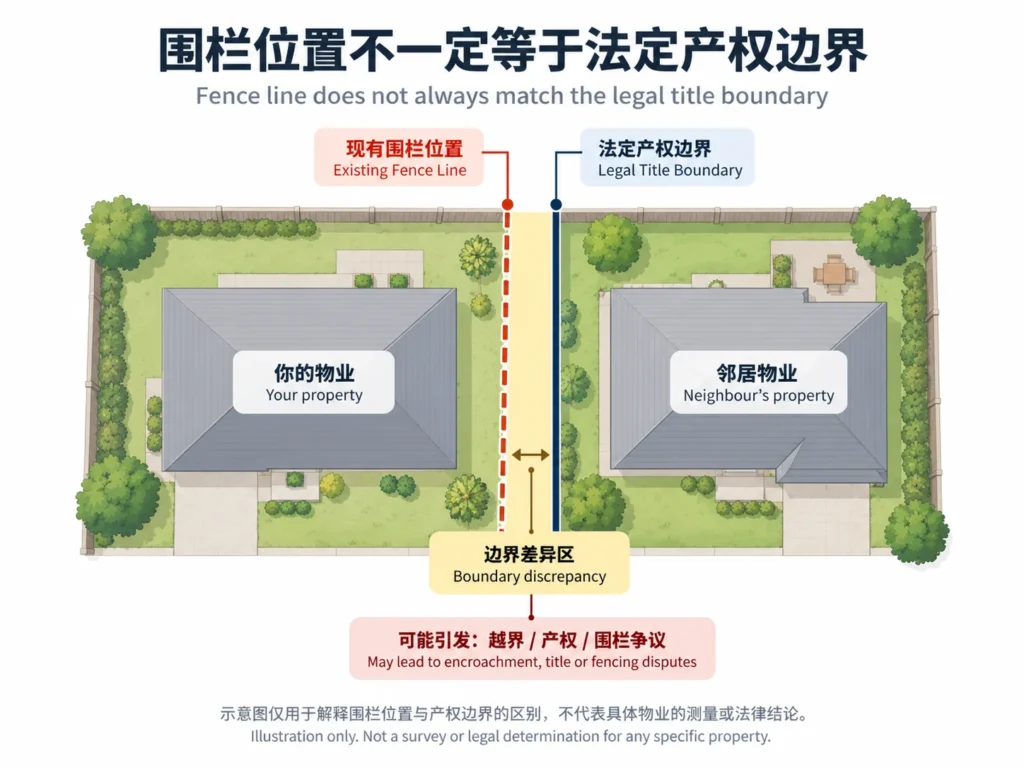
Not necessarily.
A physical fence may have been installed decades ago, replaced, or built in the wrong position. Its location does not, by itself, establish the legal property boundary.
Land Use Victoria explains that title diagrams provide an indication of boundary dimensions, but only a licensed surveyor can determine the actual location of property boundaries.
A misplaced fence does not automatically mean that the adjoining owner has acquired the land. Nor does it necessarily establish an immediate right to remove the fence.
The history of occupation, title records, survey evidence and relevant law may all be important.
What is title insurance?
Title insurance is a specialist insurance product designed to protect against specified risks affecting legal ownership or interests in property.
It differs from home building insurance, which generally addresses specified physical damage, and landlord insurance, which may address certain rental property risks.
Depending on the policy, title insurance may provide protection against:
- Boundary and survey defects: certain encroachments, boundary discrepancies and title issues that a survey could reveal.
- Planning and title defects: specified easements, access rights, restrictions and other title problems.
- Unapproved building work: certain enforcement action concerning work undertaken by previous owners without required approvals.
- Fraud and forgery: specified fraudulent activity affecting ownership.
- Outstanding rates and levies: certain existing charges or errors affecting the property.
Coverage is subject to the policy wording, exclusions, limits and property-specific endorsements.
Why is title insurance different from ordinary insurance?
Many insurance products focus on future events.
One of the distinguishing features of title insurance is that it may protect against certain problems that already existed when the policy commenced but were unknown to the purchaser.
An encroachment or title defect may remain undiscovered for years before affecting the owner’s interests.
Some policies also cover specifically defined events occurring after commencement, including certain forms of title fraud.
The relevant question is therefore not simply when the problem was discovered, but when the insured risk arose and whether it falls within the policy.
What if an encroachment is already known?
This was one of the central questions raised in the APOA discussion.
Suppose a homeowner has commissioned a boundary survey and discovered that a neighbour’s fence or structure encroaches onto their property.
Can the homeowner purchase title insurance afterwards and expect the insurer to resolve the problem?
A new standard policy should not be assumed to cover an already identified defect.
Stewart Title lists risks known to the insured but not disclosed to the insurer, as well as certain matters revealed in pre-policy reports, among its standard exclusions.
However, Stewart Title also offers case-by-case underwriting for some known risks discovered during the conveyancing process.
This does not mean that every known encroachment can be insured. Its published underwriting guidance specifically excludes certain encroachments where adjoining property owners are already aware of the issue.
Full disclosure and written confirmation from the insurer are essential.
Policyholders should also seek advice before taking steps that could trigger enforcement action, as some policies contain specific restrictions concerning action initiated by the insured.
Can title insurance replace a boundary survey?
No. They serve different purposes.
A licensed surveyor establishes the position of legal boundaries and can identify potential encroachments.
Title insurance may provide financial protection against certain insured ownership risks.
The distinction becomes particularly important with fences.
Stewart Title’s residential policy contains specific limitations concerning boundary walls and fences. Certain building enforcement protections exclude them, as does a specified category of post-policy encroachment cover.
A successful historical claim involving a misplaced fence should therefore not be interpreted as coverage for routine fence repairs, replacements or every dispute between neighbours.
Whether a survey is advisable before purchase depends on the property, intended use and potential risks. Insurance should not be treated as a substitute for appropriate due diligence.
Can existing homeowners purchase title insurance?
Potentially, yes.
Some Australian providers offer existing-owner title insurance policies to people who already own property but did not purchase cover at settlement.
These policies may be available for a one-time premium rather than annual renewal.
However, continuing protection depends on the terms of the policy. Cover does not ordinarily transfer automatically to a new purchaser when the property is sold, although certain transfers involving family members or inheritance may be treated differently.
Premiums, coverage limits and exclusions also vary. Another homeowner’s premium is not a reliable quote for a different property.
What should you do if you discover a boundary problem?
For Victorian property owners, a sensible starting point is to establish the facts before deciding how to proceed.
- Gather your documents. Keep copies of the title, registered plans, previous surveys, purchase documents, photographs and relevant correspondence.
- Consider a licensed boundary survey. Avoid relying solely on fences, marketing plans or online mapping.
- Check any existing insurance. If you hold title insurance, review your policy and contact the insurer promptly about a potential claim.
- Identify the nature of the dispute. A disagreement about fence construction or costs is not necessarily the same as a dispute over ownership of land.
- Seek appropriate assistance. Victoria Legal Aid provides information about fencing disputes, and the Dispute Settlement Centre of Victoria may assist with neighbour mediation. Questions involving legal title or historical occupation may require specialist legal advice.
Avoid making binding boundary agreements or taking action that could compromise your legal position without understanding the consequences.
Five questions to ask before buying property
A conveyancer or solicitor can help buyers consider:
- Are there any boundary, easement or encroachment concerns that warrant further investigation?
- Would an independent boundary survey be appropriate?
- What title-related risks would insurance cover for this particular property?
- Would defects disclosed in the contract, Section 32 statement or inspection reports be excluded?
- What are the policy limits, exclusions, legal cost provisions and duration of cover?
Title insurance can be a useful risk-management tool, but it does not replace proper contract review, property investigations, surveying or legal advice.
From community experience to practical property knowledge
The most valuable outcome of the APOA discussion was not a recommendation to buy a particular insurance product.
It was the opportunity to ask a broader question:
How well do we understand the land we own?
A fence that has stood for decades, an old title plan or an overlooked historical defect may become important when a property is renovated, developed or sold.
Some risks can be identified through investigation. Others may be managed through insurance. Certain disputes require professional advice or legal resolution.
The better homeowners understand these differences, the better equipped they are to make informed decisions.
APOA aims to turn everyday community conversations into practical, carefully researched knowledge that benefits a wider community of Australian property owners.
Sources and further reading
- Stewart Title — Residential Purchaser Policy
- Stewart Title — Known Risk Coverage
- Stewart Title — Existing Owner Policies
- Stewart Title — Sample Policies
- Stewart Title — Victorian Claims Examples, including Yarraville
- Land Use Victoria — Property and Land Titles Information
- Victoria Legal Aid — Fences and Trees
Community origin: Inspired by an APOA property-owner discussion on 21–22 October 2026. Participants’ identities and private communications have not been reproduced.
Editorial note: This article is based on publicly available sources and questions raised by the community. It has not yet been independently reviewed by a specialist insurance or property lawyer.
Disclaimer: This article provides general information only and is not legal, insurance, surveying or financial advice. The claim described is an individual example published by an insurer. Actual cover depends on the issued policy and individual circumstances. Seek advice from appropriately qualified professionals.
Sources reviewed: 22 October 2026.